EN
EN


Impellers are core functional components widely used in aerospace, automotive, energy power, and fluid machinery fields, whose machining quality directly determines the operational efficiency, stability, and service life of the entire equipment system. With the continuous upgrading of industrial requirements for high performance, high precision, and lightweight, impeller machining technology has undergone iterative innovation, evolving from traditional multi-process machining to integrated, intelligent, and high-precision manufacturing modes. This review systematically summarizes the core technologies, mainstream processes, technical advantages, and industry development trends of impeller machining, focusing on the application and promotion of 5-axis CNC machining technology, and provides a reference for the research and engineering practice of impeller manufacturing. It also supplements the latest research progress, typical engineering cases, and key technical challenges in the field, to make the review more comprehensive and practical.
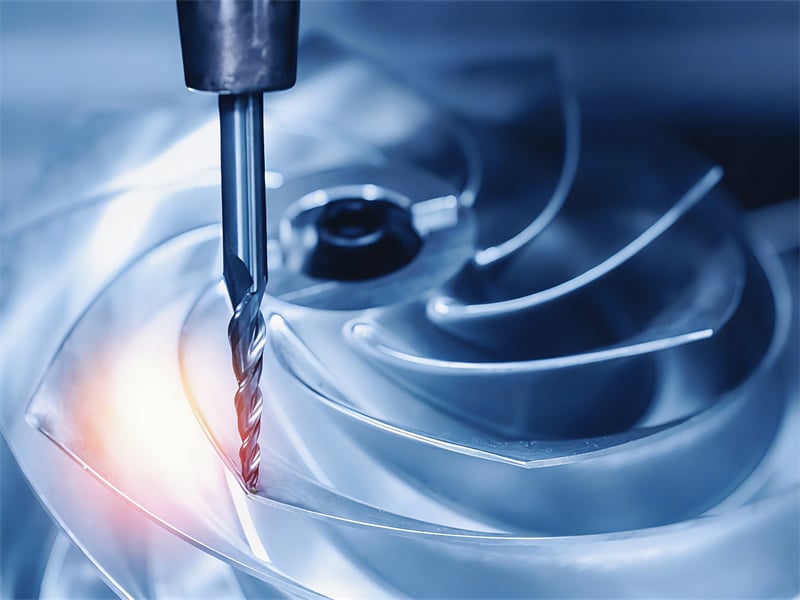
1. Overview of Impeller Machining and Core Requirements
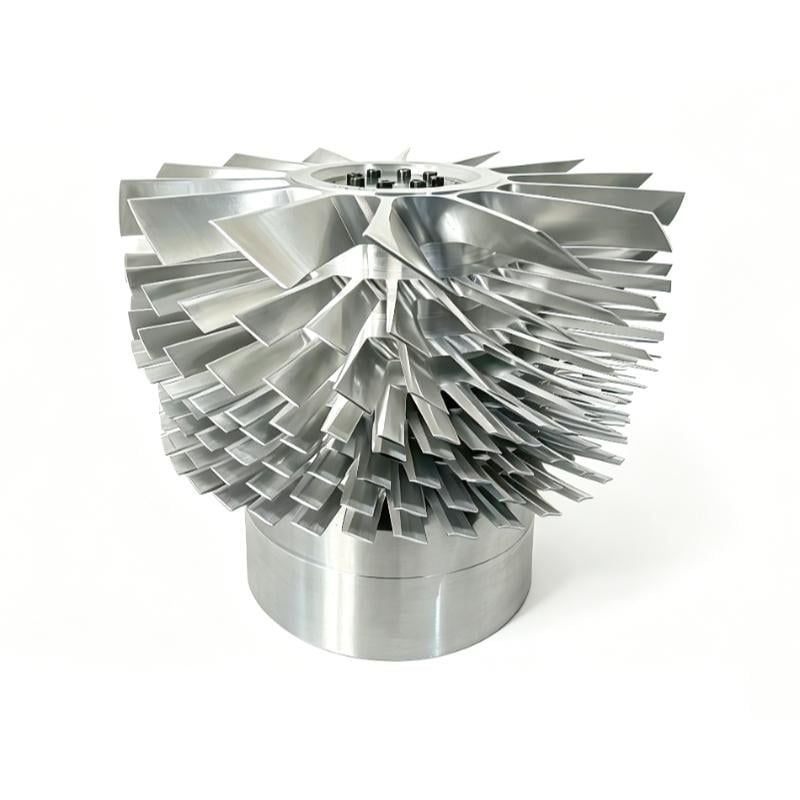
Impellers are typically composed of a wheel disc and rotating blades, with complex structural characteristics such as twisted blade profiles, high-curvature surfaces, and narrow flow channels. According to the shape and opening-closing status, impellers can be classified into different types, such as open impellers, closed impellers, and semi-open impellers. Open impellers have simple structures and are easy to process, but their efficiency is relatively low, suitable for low-pressure and low-viscosity fluid conveying; closed impellers have good sealing performance and high efficiency, which are widely used in high-pressure and high-efficiency equipment; semi-open impellers balance the advantages of the two types and are applied in scenarios with moderate requirements. The machining process of impellers involves multiple links including design development, process planning, raw material preparation, machining, heat treatment, surface treatment, and inspection and acceptance. The core requirements of impeller machining mainly focus on three aspects: dimensional precision, surface quality, and structural integrity. Specifically, the dimensional tolerance of key surfaces such as blade profiles and wheel discs needs to reach micron-level accuracy; the surface roughness needs to be controlled to a very low level (usually Ra≤0.8μm for general impellers, and Ra≤0.1μm for high-precision impellers in aerospace field) to reduce fluid resistance and improve aerodynamic or hydrodynamic performance; and the internal and external structures must be free of defects such as cracks and burrs to ensure operational safety under high-speed and high-load conditions. In addition, for impellers used in extreme environments (such as high temperature, high pressure, and strong corrosion), material compatibility and fatigue resistance also need to meet strict requirements.
Against the background of the continuous expansion of the impeller industry scale and the increasing market demand, the traditional machining methods have gradually been unable to meet the high-performance requirements of modern impellers. The development of advanced machining technologies, represented by 5-axis CNC machining, has become the key to breaking through the technical bottlenecks of impeller manufacturing. According to the data released by the International Association of Machining Technology, the global high-precision impeller market size will reach 8.7 billion US dollars by 2028, with an annual growth rate of 6.2%, which also puts forward higher requirements for the innovation and upgrading of impeller machining technology.
2. Mainstream Machining Technologies for Impellers
2.1 Traditional Impeller Machining Technologies
In the early stage of impeller manufacturing, traditional machining technologies such as turning, milling, and drilling were mainly adopted. These technologies require multiple workholding reconfigurations and tool changes during the machining process, which not only increases the auxiliary time of processing but also easily introduces cumulative positioning errors and geometric deviations due to repeated clamping. For example, when machining the wheel disc and blades separately by traditional milling, the positioning error between the two parts can reach 0.1-0.2mm, which seriously affects the assembly accuracy and operational stability of the impeller. In addition, for impellers with complex curved surfaces and twisted blades, traditional machining methods have limitations in tool accessibility, making it difficult to ensure the consistency of blade profiles and surface quality, and the production efficiency is relatively low. With the improvement of industrial requirements, traditional machining technologies are gradually being replaced by advanced integrated machining technologies, but they still play a role in the machining of simple-structured impellers and rough machining links. For example, in the rough machining of large-scale water turbine impellers, traditional gantry milling is still used to remove most of the redundant material, which can reduce the processing load of subsequent precision machining and reduce the cost.
2.2 5-Axis CNC Machining Technology: The Core of Modern Impeller Machining
5-axis CNC machining technology has become the premier solution for high-performance impeller manufacturing due to its unique technical advantages, and it has been widely used in the machining of high-precision impellers in aerospace, energy, and other fields. Different from traditional 3-axis machining, 5-axis CNC machining realizes the linkage control of three linear axes (X, Y, Z) and two rotational axes (A, B or A, C), which can adjust the orientation of the tool and the workpiece in real time during the machining process, effectively solving the problem of tool accessibility in complex surface machining. Compared with 3-axis machining, 5-axis CNC machining can reduce the number of tool changes by 60% and improve the machining accuracy by more than 50% when processing complex impellers.
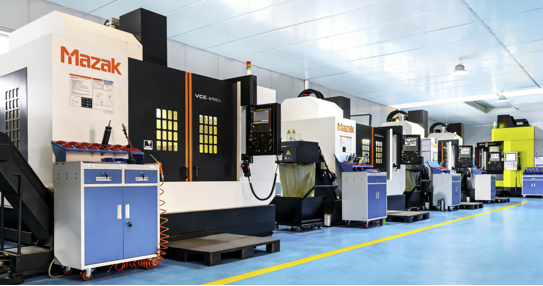
The application of 5-axis CNC machining in impeller manufacturing involves multiple key links. In the process development stage, professional software such as UG, NREC, and hyperMILL is used for process route design, CNC program compilation, and tool path planning, laying a foundation for high-precision machining. Among them, NREC software is specially designed for turbomachinery machining, which can realize parameterized design of impeller blades and optimize tool paths to avoid tool interference. In the machining stage, 5-axis linkage machining centers (including large-scale 5-axis gantry machining centers, vertical 5-axis machining centers, etc.) are used to complete milling, profiling, and finishing operations in a single clamping, minimizing human-induced errors and ensuring consistent geometric precision across production batches. Meanwhile, supporting detection equipment such as handheld 3D scanners, coordinate measuring machines (CMM), and horizontal hard-bearing balancing machines are used to conduct real-time quality inspection during the machining process, ensuring that the dimensional accuracy and surface quality meet the technical requirements. For example, the CMM can detect the dimensional error of the blade profile with an accuracy of ±0.005mm, which provides a reliable guarantee for the machining quality of the impeller.
In recent years, 5-axis CNC machining technology has achieved continuous innovation. For example, the intelligent 5-axis blade machining center launched in China adopts an advanced 3+2 axis distribution structure, equipped with gapless torque motors and high-power high-torque electric spindles, with a maximum speed of 20,000 rpm, which can realize efficient and precise machining of small and medium-sized impeller blades. In addition, the integration of artificial intelligence (AI) technology into the 5-axis CNC system has realized adaptive adjustment of machining parameters and real-time monitoring of the machining process, further improving the stability and efficiency of impeller machining. For instance, the AI-based tool wear monitoring system can predict tool life according to the cutting force, temperature, and other parameters during machining, and remind operators to replace tools in time, reducing the scrap rate caused by tool wear. Moreover, the development of 5-axis high-speed machining technology has shortened the machining cycle of impellers by 30%-40%, which is widely used in the mass production of automotive turbocharger impellers.
2.3 Auxiliary Machining Technologies and Supporting Processes
The high-quality machining of impellers cannot be separated from the support of auxiliary technologies and supporting processes. In the raw material preparation stage, strict incoming inspection is carried out on raw materials through visual inspection, calipers, 3D laser scanners, and third-party testing institutions to ensure that the chemical composition, mechanical properties, and heat treatment status of the raw materials meet the technical requirements. Common raw materials for impellers include titanium alloys, nickel-based superalloys, stainless steel, and aluminum alloys. Among them, nickel-based superalloys are widely used in aerospace impellers due to their excellent high-temperature resistance and fatigue resistance, but their machining difficulty is relatively high, requiring the use of special cutting tools and machining parameters. In the post-machining stage, processes such as heat treatment, deburring, polishing, and surface treatment are adopted to improve the mechanical properties and surface quality of the impeller. For example, heat treatment can enhance the hardness and wear resistance of the impeller; deburring and polishing can eliminate surface defects and reduce fluid resistance; surface treatment technologies such as electroplating and painting can improve the corrosion resistance of the impeller. In addition, shot peening technology is often used to improve the fatigue life of impeller blades, which can increase the fatigue strength of the blades by 20%-30%.
In addition, composite machining technologies such as 5-axis turning-milling composite machining have also been gradually applied in impeller manufacturing. This technology can complete turning, milling, boring, drilling, and other processes in a single clamping, shortening the production cycle and improving machining efficiency, which is particularly suitable for the machining of impellers with complex structures and small and medium-sized batches. For example, the 5-axis turning-milling composite machining center can machine the wheel disc and blades of the impeller in one clamping, reducing the positioning error caused by multiple clamping and improving the machining accuracy. In addition, additive manufacturing (3D printing) technology has also been applied in impeller manufacturing in recent years. This technology can directly manufacture impellers with complex internal structures, which is difficult to achieve by traditional machining methods, and can reduce the material waste rate by more than 50%. At present, 3D printing technology is mainly used in the development and small-batch production of impellers, and its application scope is gradually expanding with the improvement of printing precision and efficiency.
3. Key Technical Advantages of Advanced Impeller Machining
3.1 High Precision and Dimensional Consistency
Advanced machining technologies represented by 5-axis CNC machining realize single-setup fabrication of impellers, avoiding cumulative errors caused by multiple clamping. The high-performance servo control system and adaptive tool path planning ensure stable tool path trajectory and uniform cutting force, enabling the dimensional tolerance of the impeller to reach micron-level accuracy and ensuring good dimensional consistency between batches. For example, in the machining of aircraft engine impellers, 5-axis CNC machining can control the machining deformation within 0.05mm/m, which meets the high-precision requirements of aerospace equipment. Taking the C919 large civil aircraft engine impeller as an example, the dimensional tolerance of its blade profile is controlled within ±0.01mm, and the surface roughness reaches Ra≤0.08μm, which ensures the aerodynamic performance of the engine. In addition, the use of online detection technology in the machining process can timely correct the machining errors, further improving the machining precision and dimensional consistency of the impeller.
3.2 Enhanced Design Flexibility
The multi-axis rotational capability of 5-axis CNC machining breaks through the limitations of traditional machining on impeller design, supporting the manufacture of high-curvature blades, twisted profiles, and integrated flow-optimized structures that were previously unachievable. This expanded design envelope provides more space for the optimization of aerodynamic and hydrodynamic performance of impellers, helping to reduce flow resistance and improve energy conversion efficiency. For example, the new impeller linear structure developed by some enterprises has increased the volumetric efficiency by 18% compared with traditional models. Another example is the bionic impeller designed based on the structure of bird wings, which adopts a variable-curvature blade profile, and its energy conversion efficiency is 15% higher than that of traditional impellers. In addition, the application of additive manufacturing technology further expands the design space of impellers, allowing designers to design more complex structures according to the actual working conditions, so as to achieve better performance.
3.3 Improved Production Efficiency and Cost Reduction
The integration of multi-process operations into a single setup streamlines the workflow, eliminates redundant positioning steps, and shortens the production cycle. The application of automated control technology realizes uninterrupted machining, reduces labor input, and improves the first-pass yield, thereby reducing overall manufacturing costs. For example, the application of 5-axis CNC machining technology can improve the programming efficiency by more than 3 times and the machining efficiency by more than 30% compared with traditional machining methods. Taking the automotive turbocharger impeller as an example, the traditional machining method takes about 2 hours to process one impeller, while the 5-axis CNC machining can shorten the time to 40 minutes, and the first-pass yield is increased from 85% to 98%. In addition, the use of intelligent tool management systems can reduce tool loss and improve tool utilization, further reducing the manufacturing cost of impellers. According to the statistics of relevant enterprises, the application of advanced impeller machining technologies can reduce the overall manufacturing cost by 20%-30%.
3.4 Superior Surface Quality and Extended Service Life
Advanced machining technologies can produce ultra-smooth surfaces, and the surface roughness can reach Ra≤0.08μm when machining mold steel, which effectively reduces fluid resistance and improves the operational stability of the impeller. At the same time, the optimized cutting posture reduces the mechanical stress and wear of the tool, extending the service life of the tool and reducing tooling costs. The integrated high-efficiency cooling and lubrication system dissipates cutting heat, prevents thermal deformation and tool failure, and further ensures the stability of the machining process and the service life of the impeller. For example, the high-pressure cooling system can spray cutting fluid to the cutting area at a pressure of 100-200bar, which can reduce the cutting temperature by 30%-40%, avoid thermal deformation of the impeller, and extend the tool life by 50% or more. In addition, the surface treatment technology such as ceramic coating can improve the wear resistance and corrosion resistance of the impeller, extending its service life by 2-3 times. For impellers used in marine environments, the use of anti-corrosion coatings can effectively prevent seawater corrosion and ensure the long-term stable operation of the impeller.
4. Industry Application Status and Development Trends
4.1 Application Status
Impeller machining technology has been widely applied in various fields. In the aerospace field, 5-axis CNC machining technology is used to machine high-precision impellers for aircraft engines and gas turbines, which has been applied in the development and production of multiple military aircraft and civil aircraft such as C919 and ARJ21. For example, the impeller of the C919 engine is machined by 5-axis high-speed CNC machining technology, which ensures the high precision and high reliability of the engine. In the energy field, impellers for wind turbines, water turbines, and magnetic levitation fans are machined with advanced technologies to improve energy conversion efficiency. The impeller of a large wind turbine has a diameter of more than 10 meters, and its machining requires the use of large-scale 5-axis gantry machining centers, which can ensure the dimensional accuracy and surface quality of the impeller. In the automotive field, impellers for automotive turbochargers and thermal management systems are manufactured with high-precision machining technologies to enhance the performance of automotive engines. With the continuous improvement of industrialization level, the application scope of impeller machining technology is still expanding. In addition, impellers are also widely used in chemical, petroleum, and other fields, such as the impellers of chemical pumps and oil pumps, which require high corrosion resistance and wear resistance.
At present, the global impeller machining industry is showing a trend of concentration. Leading enterprises in Europe, America, and Japan have advanced machining technologies and equipment, and occupy a dominant position in the high-end impeller market. Domestic enterprises are also accelerating the research and development of impeller machining technology, and have made remarkable achievements in the field of medium and low-end impellers. With the continuous breakthrough of domestic high-end machining equipment and core technologies, the competitiveness of domestic impeller products in the global market is gradually improving.
4.2 Future Development Trends
With the in-depth development of intelligent manufacturing and industrial 4.0, impeller machining technology will show the development trends of intelligence, integration, and localization. Firstly, intelligent machining will become the mainstream direction. The integration of artificial intelligence, digital twin, and Internet of Things (IoT) technologies into the impeller machining process will realize real-time monitoring, fault diagnosis, and parameter optimization of the machining process, improving the intelligence level of manufacturing. For example, the digital twin technology can establish a virtual model of the impeller machining process, simulate the machining process, predict the machining errors, and optimize the machining parameters in advance, which can reduce the trial production cycle and improve the machining quality. Secondly, the integration of machining and inspection will be further strengthened. The combination of online detection and offline detection will form a closed-loop quality control system, ensuring the machining quality of impellers. The online detection technology can detect the machining quality in real time during the machining process, and feed back the detection results to the CNC system to adjust the machining parameters in time, realizing the dynamic control of the machining process. Finally, the localization of high-end machining equipment will be accelerated. At present, the high-precision impeller machining equipment market is still dominated by foreign products. With the continuous breakthrough of domestic research and development, the localization rate of high-end 5-axis CNC machining centers, CNC systems, and core components will be continuously improved, providing strong support for the independent research and development and manufacturing of high-performance impellers in China. In addition, the green machining of impellers will also become an important development trend. The use of environmentally friendly cutting fluids, energy-saving equipment, and material-saving technologies can reduce the environmental impact of the machining process and realize the sustainable development of the impeller manufacturing industry.
5. Technical Challenges and Countermeasures
Although impeller machining technology has made great progress in recent years, it still faces some technical challenges in the process of practical application. Firstly, the machining difficulty of high-performance materials is high. Nickel-based superalloys, titanium alloys, and other materials used in aerospace and other fields have high hardness, high toughness, and poor machinability, which easily cause tool wear, machining deformation, and other problems during machining. To solve this problem, it is necessary to develop special cutting tools (such as diamond tools and cubic boron nitride tools) and optimize the machining parameters, such as reducing the cutting speed and feed rate, and increasing the cutting depth appropriately. Secondly, the tool path planning of complex curved surface impellers is difficult. The blade profile of the impeller is complex, and the tool path planning needs to consider the tool interference, machining efficiency, and machining quality, which requires the use of advanced software and algorithms to optimize the tool path. Thirdly, the cost of high-end machining equipment is high. The price of high-end 5-axis CNC machining centers is usually millions of yuan, which increases the investment cost of enterprises. To solve this problem, domestic enterprises need to accelerate the localization of high-end equipment, reduce the production cost of equipment, and improve the cost performance of equipment.
6. Conclusion
Impeller machining technology is an important part of advanced manufacturing technology, and its development level is closely related to the upgrading of the aerospace, energy, and automotive industries. 5-axis CNC machining technology, as the core of modern impeller machining, has obvious advantages in precision, efficiency, and flexibility, and has become the key to realizing high-performance impeller manufacturing. With the continuous innovation of auxiliary technologies and supporting processes, and the in-depth integration of intelligent technologies, impeller machining technology will move towards a more precise, efficient, and intelligent direction, providing strong technical support for the development of related industries. In the future, it is necessary to further strengthen the research and development of core technologies, solve the existing technical challenges, promote the localization of high-end equipment, and promote the high-quality development of the impeller manufacturing industry. At the same time, it is also necessary to strengthen international cooperation and exchange, learn from advanced foreign technologies and experience, and improve the global competitiveness of domestic impeller products.
 Hot News